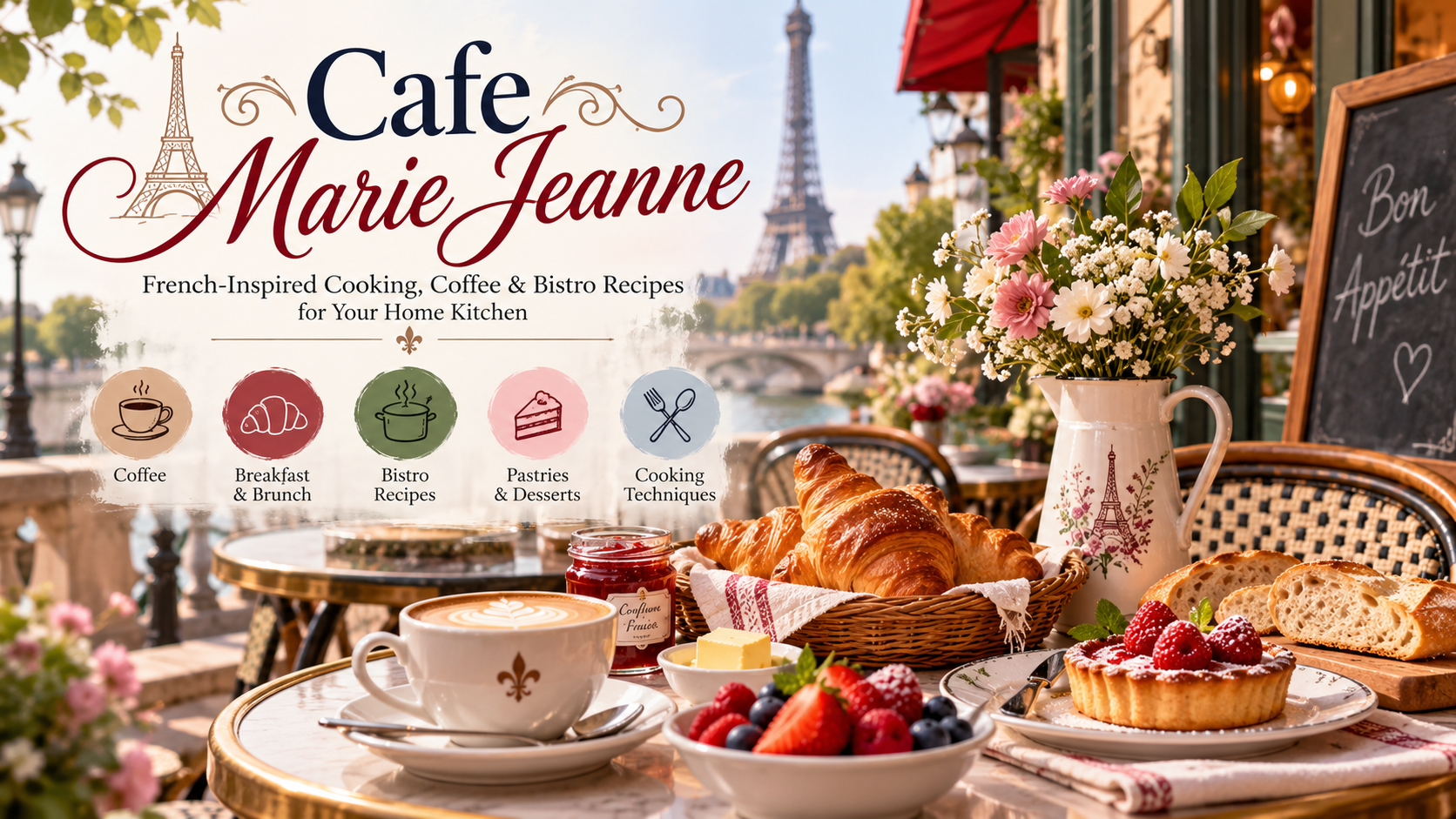






Cafe Marie Jeanne | French Recipes, Café Drinks & Cooking Guides

Welcome to Cafe Marie Jeanne, an editorial guide to French-inspired cooking at home—from a thoughtfully brewed morning coffee and a simple tartine to slow-cooked bistro dishes, delicate pastries and dependable sauces. You do not need a professional kitchen to learn the methods behind memorable French food. You need clear steps, appropriate ingredients and an understanding of what each technique is meant to accomplish.

Explore our 20 topic collections to find recipes, comparisons and practical explanations. We distinguish the broad overview on this page from dedicated recipe guides, where precise quantities, times, temperatures and step-by-step methods belong. Our goal is to help you decide what to make, what to learn first and what can go wrong before you begin.

Quick Answer: What Can You Learn Here?

Cafe Marie Jeanne is a guide to French café drinks, French recipes and practical French cooking techniques. Start with coffee and breakfast if you are new to the cuisine; explore bistro classics for complete meals; move into bread, pastry, sauces and regional dishes as your confidence grows. Each collection points toward focused guides so you can explore a topic without having to read a full cookbook first.

Start Here: Find the Right French Recipe or Technique

Use your immediate goal to select a guide. The simplest entry point is not always the most famous dish; it is the one that fits your time, equipment and appetite.

Your goal Where to begin What you will learn
Make better coffee French Press Coffee Ratio, grind, extraction and texture
Prepare a relaxed morning meal Traditional French Breakfast Simple pairings and make-ahead choices
Cook a French dinner French Bistro Food Classic dishes and menu planning
Learn to bake Croissants or French Baguette Lamination versus lean dough
Improve sauces French Mother Sauces Thickening, reduction and emulsions
Finish a meal Classic French Desserts Custards, mousses and fruit desserts

Explore the 20 French Café & Cooking Pillars

These collections form a structured reading path, not 20 copies of the same recipe. Each pillar has a distinct job: a broad introduction here, followed by more specialized articles covering exact methods, comparisons or troubleshooting.

HUB 01: Coffee & Brewing

What This Pillar Covers

Coffee extraction is a balance of dose, grind, water temperature and contact time—not a single secret setting. For a French press, begin with a reproducible ratio, record your grind and steeping time, then adjust only one variable at a time. Cloudy coffee is not automatically defective: a metal filter allows more oils and fine particles through than a paper filter.

Technique, Troubleshooting & Better Decisions

A cup that tastes hollow may need a higher dose or more extraction; a harsh, drying cup may call for a coarser grind or shorter contact. Pour gently after brewing and avoid leaving the finished coffee sitting on the grounds for an extended period.

How to Use This Collection

Compare immersion and filtered methods by body, clarity and cleanup. Use a kitchen scale and consistent water quality before investing in new equipment.

Explore the focused guides: French Press Coffee, French Press Coffee Ratio, French Press Grind Size, Why French Press Coffee Bitter, Why French Press Coffee Weak. Each guide addresses a narrower question; its dedicated page should provide the full instructions or comparisons.

HUB 02: French Breakfast & Brunch

What This Pillar Covers

A French breakfast can be remarkably simple: bread or a pastry, butter, preserves and a hot drink. A leisurely brunch may add eggs, savory sandwiches or a baked dish, but those are choices rather than requirements for a traditional morning meal.

Technique, Troubleshooting & Better Decisions

For French toast, the challenge is getting a custardy center without a wet, collapsing slice. Bread thickness, dryness, soaking time and pan temperature matter more than piling on toppings. Croque monsieur belongs to the savory café tradition; balance crisp bread, filling and sauce instead of treating it like an ordinary cold sandwich.

How to Use This Collection

Choose a weekday breakfast around freshness and speed; reserve enriched dough and baked brunch dishes for occasions when you can plan ahead.

Explore the focused guides: Traditional French Breakfast, French Toast, Why French Toast Soggy, Croque Monsieur, Croque Madame. Each guide addresses a narrower question; its dedicated page should provide the full instructions or comparisons.

HUB 03: French Bistro Classics

What This Pillar Covers

Bistro classics are built around dependable cooking decisions: develop flavor, manage moisture, and finish sauces with restraint. Onion soup depends on thoroughly softened and browned onions rather than an aggressive shortcut; ratatouille benefits from respecting the different moisture levels of its vegetables.

Technique, Troubleshooting & Better Decisions

A quiche is a custard in a pastry shell, so the set of the filling and the condition of the crust matter separately. When planning a bistro meal, choose one dish requiring last-minute attention and pair it with sides that can wait.

How to Use This Collection

A home bistro menu need not imitate restaurant complexity. A well-made main dish, a crisp salad and bread can be more satisfying than several elaborate courses.

Explore the focused guides: French Bistro Food, French Onion Soup, Quiche Lorraine, Ratatouille, Coq au Vin. Each guide addresses a narrower question; its dedicated page should provide the full instructions or comparisons.

HUB 04: French Baking & Pastries

What This Pillar Covers

French pastry rewards controlled temperature and repeatable technique. Croissants and pain au chocolat rely on lamination: layers of dough and butter are created through folding, while yeast fermentation and proofing also influence the finished structure. Brioche is an enriched dough, not a laminated pastry.

Technique, Troubleshooting & Better Decisions

If butter smears into the dough during rolling, pause and chill before continuing. Dense pastries can have several causes, including inadequate proofing, damaged layers or baking conditions; diagnose the process instead of blaming one ingredient.

How to Use This Collection

Plan pastry by stages: mix, rest, shape, proof and bake. A thermometer and careful notes are more useful than rushing to reproduce a photograph.

Explore the focused guides: Croissants, Why Croissants Dense, Brioche, Pain au Chocolat, Choux Pastry. Each guide addresses a narrower question; its dedicated page should provide the full instructions or comparisons.

HUB 05: French Bread & Dough

What This Pillar Covers

Bread is a study in fermentation, gluten development, shaping and heat. A baguette is not simply any loaf formed into a long shape: the dough structure, surface tension, scoring and baking environment all influence crust and crumb.

Technique, Troubleshooting & Better Decisions

An overly dense loaf may reflect underfermentation, insufficient dough strength, rough shaping or inadequate oven spring. Fresh baguettes are at their best soon after baking; for later use, store appropriately and re-crisp in an oven rather than assuming refrigeration will preserve texture.

How to Use This Collection

Distinguish lean bread dough from enriched dough. This makes it easier to understand why baguette, brioche and sandwich bread require different handling.

Explore the focused guides: French Baguette, Dense Baguette, Store Baguette, Reheat Baguette, Score Bread. Each guide addresses a narrower question; its dedicated page should provide the full instructions or comparisons.

Cafe Marie Jeanne
Cafe Marie Jeanne

HUB 06: French Cheese & Dairy

What This Pillar Covers

French cheese is not a single flavor profile. Soft-ripened cheeses such as Brie differ from fresh, blue-veined, pressed and aged styles in moisture, aroma and serving behavior. Temperature changes the way a cheese tastes and spreads, but food-safety storage requirements still apply.

Technique, Troubleshooting & Better Decisions

When building a cheese plate, contrast textures and intensities rather than selecting several cheeses that taste nearly identical. Check the product label for milk type, pasteurization and storage instructions; these details matter more than romantic descriptions of origin.

How to Use This Collection

For cooking, distinguish cheeses chosen to melt smoothly from those used for sharp flavor or finishing. Avoid substituting purely by color or appearance.

Explore the focused guides: Brie Cheese, Eat Brie, Store Brie, Freeze Brie, Camembert. Each guide addresses a narrower question; its dedicated page should provide the full instructions or comparisons.

HUB 07: French Cooking Techniques

What This Pillar Covers

Technique guides are the foundation beneath many French recipes. Deglazing uses liquid to loosen flavorful browned deposits from a pan; it works best when the deposits are browned rather than burned. A roux thickens through cooked flour and fat, while an emulsion depends on keeping ingredients dispersed.

Technique, Troubleshooting & Better Decisions

For a pan sauce, control the saltiness of stock before reducing it. If a butter-enriched sauce looks greasy or separates, remove it from high heat and assess whether excess temperature or an unstable emulsion is the problem.

How to Use This Collection

Learn the underlying method once, then apply it to chicken, steak, vegetables and seafood. Technique transfers across dishes without repeating an entire recipe.

Explore the focused guides: Deglaze Pan, Pan Sauce, Roux, Fix Broken Sauce, Caramelize Onions. Each guide addresses a narrower question; its dedicated page should provide the full instructions or comparisons.

HUB 08: French Desserts

What This Pillar Covers

French desserts range from custards and mousses to fruit tarts and baked pastries. They should not all be approached with the same method: crème brûlée requires gentle custard setting and a separately caramelized top, while chocolate mousse relies on carefully managing chocolate temperature and aeration.

Technique, Troubleshooting & Better Decisions

Tarte Tatin asks you to consider caramel and fruit moisture before adding pastry. Select dessert by the equipment available and by whether it can be prepared ahead; chilled desserts and last-minute caramelized finishes suit different schedules.

How to Use This Collection

A reliable dessert is one whose texture you understand. Learn the signs of a set custard, stable foam and properly baked pastry before adding decoration.

Explore the focused guides: Classic French Desserts, Crème Brûlée, Chocolate Mousse, Tarte Tatin, Cherry Clafoutis. Each guide addresses a narrower question; its dedicated page should provide the full instructions or comparisons.

HUB 09: French Café Drinks

What This Pillar Covers

French café drink names are useful starting points, not universally standardized formulas. Café au lait generally combines coffee with hot milk, while café crème is commonly associated with espresso-style café service; exact proportions and local practice vary.

Technique, Troubleshooting & Better Decisions

French hot chocolate is often prepared for a richer texture than ordinary cocoa-based drinks, but richness can be adjusted. For milk drinks, begin with the coffee base and desired texture before chasing an exact café ratio.

How to Use This Collection

Keep the coffee-brewing method separate from the drink assembly. A good milk drink cannot reliably rescue an overextracted or stale base.

Explore the focused guides: Café au Lait, Café Crème, French Hot Chocolate, Café Noisette, Froth Milk Without Frother. Each guide addresses a narrower question; its dedicated page should provide the full instructions or comparisons.

HUB 10: French Sandwiches

What This Pillar Covers

French sandwiches demonstrate how a few well-chosen ingredients can make a complete meal. Jambon-beurre depends on the quality and balance of bread, butter and ham; pan bagnat is a different experience, designed around a substantial filling and bread that can absorb some dressing.

Technique, Troubleshooting & Better Decisions

For baguette sandwiches, consider crust firmness and how easily the sandwich can be bitten through. Layer wetter ingredients thoughtfully so the bread stays pleasant during transport.

How to Use This Collection

Choose a sandwich according to when it will be eaten: a freshly assembled café lunch and a packed picnic sandwich need different moisture management.

Explore the focused guides: Traditional French Sandwiches, Jambon-Beurre, Pan Bagnat, French Tartine, Baguette Sandwich Ahead of Time. Each guide addresses a narrower question; its dedicated page should provide the full instructions or comparisons.

Cafe Marie Jeanne
Cafe Marie Jeanne

HUB 11: French Salads

What This Pillar Covers

A French salad can be a side, a starter or a substantial meal. Niçoise and Lyonnaise salads are recognizable families of dishes, but recipes and local interpretations vary; avoid claiming that one contemporary arrangement is the only legitimate version.

Technique, Troubleshooting & Better Decisions

The dressing should support the ingredients rather than overwhelm them. Dry leaves thoroughly, season components deliberately, and dress delicate greens close to serving. A warm element, such as potatoes or a cooked egg, changes both timing and texture.

How to Use This Collection

Plan salads around contrast: crisp, tender, acidic, rich and savory. Use a restrained vinaigrette and taste before adding more salt.

Explore the focused guides: Traditional French Salads, Niçoise Salad, Lyonnaise Salad, French Carrot Salad, French Lentil Salad. Each guide addresses a narrower question; its dedicated page should provide the full instructions or comparisons.

HUB 12: French Soups

What This Pillar Covers

French soups include clear broths, puréed vegetable soups, legumes and regional preparations. Potage Parmentier emphasizes the texture of potato and leek; soupe au pistou is a vegetable-centered soup typically finished with an aromatic basil mixture.

Technique, Troubleshooting & Better Decisions

For puréed soup, control the amount of liquid before blending—you can thin a soup more easily than you can rescue an excessively watery one. For lentil soup, adjust cooking time to the type and age of the lentils rather than relying on a rigid clock.

How to Use This Collection

Build flavor in stages: sweat aromatics, cook ingredients to their proper tenderness, and finish seasoning only after reduction or blending.

Explore the focused guides: Traditional French Soups, Potage Parmentier, Soupe au Pistou, French Lentil Soup, Vichyssoise. Each guide addresses a narrower question; its dedicated page should provide the full instructions or comparisons.

HUB 13: French Sauces & Condiments

What This Pillar Covers

The classical French sauce framework provides useful vocabulary, but a home cook does not need to memorize every derivative to make dinner. Béchamel uses a milk-based thickened foundation; velouté generally begins with a light stock and roux. Hollandaise and béarnaise require attention to emulsion and temperature.

Technique, Troubleshooting & Better Decisions

For any sauce, identify the thickening or emulsifying mechanism first. A flour-thickened sauce that tastes raw needs different treatment from a butter sauce that has separated.

How to Use This Collection

Use sauces to add moisture, acidity and contrast—not to cover up an underseasoned main ingredient. Adjust salt after any significant reduction.

Explore the focused guides: French Mother Sauces, Béarnaise Sauce, Velouté Sauce, Mornay Sauce, Bordelaise Sauce. Each guide addresses a narrower question; its dedicated page should provide the full instructions or comparisons.

HUB 14: French Potato Dishes

What This Pillar Covers

Potato dishes show how the same ingredient changes with slicing, fat, liquid and heat. Gratin dauphinois is built around thin potato slices baked with dairy; pommes Anna emphasizes layered potatoes and butter. Pommes dauphine uses a different structure involving mashed potato and choux pastry.

Technique, Troubleshooting & Better Decisions

Choose waxier or starchier potatoes according to the texture you want, and keep slice thickness consistent so the dish cooks evenly. Do not expect a deeply browned top to guarantee a tender center: test the potatoes themselves.

How to Use This Collection

Potato sides can often be scheduled around the main dish, but crisp preparations are best served promptly after cooking.

Explore the focused guides: Classic French Potato Dishes, Gratin Dauphinois, Pommes Anna, Pommes Dauphine, Duchess Potatoes. Each guide addresses a narrower question; its dedicated page should provide the full instructions or comparisons.

HUB 15: French Vegetable Sides

What This Pillar Covers

French vegetable sides become interesting when the cooking method respects the vegetable. Haricots verts amandine contrasts tender-crisp green beans with almonds; glazed carrots balance liquid reduction, fat and sweetness; braised leeks require careful washing because grit can hide between layers.

Technique, Troubleshooting & Better Decisions

For green vegetables, stop cooking while they retain texture and finish close to serving. For glazing, reduce liquid gradually and avoid letting sugars scorch. For braising, keep the liquid level and heat gentle enough to soften without breaking down the vegetables.

How to Use This Collection

Treat vegetable sides as distinct dishes with their own seasoning and texture, not as filler around the protein.

Explore the focused guides: Classic French Vegetable Side Dishes, Haricots Verts Amandine, French Glazed Carrots, Braised Leeks, Braised Endives. Each guide addresses a narrower question; its dedicated page should provide the full instructions or comparisons.

Cafe Marie Jeanne
Cafe Marie Jeanne

HUB 16: French Chicken Recipes

What This Pillar Covers

French chicken cooking ranges from quick pan dishes to slowly simmered preparations. Chicken chasseur emphasizes a mushroom-and-tomato-influenced sauce; chicken Provençal commonly draws on Mediterranean aromatics; poulet basquaise uses peppers and tomatoes in a Basque-inspired preparation.

Technique, Troubleshooting & Better Decisions

Select the chicken cut to match the method. Lean breast meat can dry out during a long simmer, while dark meat is often more forgiving. For food safety, cook poultry to a safe internal temperature using a food thermometer rather than judging by color alone.

How to Use This Collection

Build flavor by browning without scorching, then control the simmer and finish the sauce separately if necessary.

Explore the focused guides: Classic French Chicken Dishes, Chicken Chasseur, Chicken Provençal, Poulet Basquaise, French Mustard Chicken. Each guide addresses a narrower question; its dedicated page should provide the full instructions or comparisons.

HUB 17: French Meat Recipes

What This Pillar Covers

French meat dishes are defined as much by method as by cut. Steak au poivre relies on careful searing and a pepper-forward pan sauce; blanquette de veau is a gently cooked, pale-sauce preparation; cassoulet is a substantial bean-and-meat dish associated with regional traditions and many interpretations.

Technique, Troubleshooting & Better Decisions

Avoid treating these dishes as interchangeable. A steak demands precise timing and resting; a braise benefits from gradual tenderness; a bean casserole requires attention to moisture and seasoning across a longer cook.

How to Use This Collection

When adapting a recipe, preserve its central technique even if a particular ingredient must change. That keeps the result coherent.

Explore the focused guides: Classic French Meat Dishes, Steak au Poivre, Blanquette de Veau, Cassoulet, Pork Rillettes. Each guide addresses a narrower question; its dedicated page should provide the full instructions or comparisons.

HUB 18: French Seafood Recipes

What This Pillar Covers

Seafood preparations reward precise timing and fresh ingredients. Sole meunière illustrates light flouring, sautéing and a butter-lemon finish; moules marinières is built around quickly cooked mussels and an aromatic cooking liquid. Bouillabaisse is a regional fish-soup tradition with many important variations.

Technique, Troubleshooting & Better Decisions

Buy seafood from a reputable source and follow current food-safety advice. Discard mussels with broken shells and any that fail appropriate pre-cooking checks; after cooking, follow reliable shellfish-safety guidance rather than using one visual cue as the sole test.

How to Use This Collection

Prepare garnishes and sauces before seafood enters the pan. Overcooking is often harder to fix than a sauce that needs one final adjustment.

Explore the focused guides: Classic French Seafood Dishes, Bouillabaisse, Sole Meunière, Moules Marinières, Coquilles Saint-Jacques. Each guide addresses a narrower question; its dedicated page should provide the full instructions or comparisons.

HUB 19: Savory Tarts & Quiches

What This Pillar Covers

Savory tarts are built on a balance of pastry, filling moisture and egg custard where applicable. Quiche Florentine features spinach; leek quiche highlights a vegetable that should be cooked and drained appropriately before baking. Tarte flambée is a different thin-crust preparation and should not be described as a quiche.

Technique, Troubleshooting & Better Decisions

A soggy bottom can result from an underbaked crust or overly wet filling. Manage moisture, use the appropriate baking vessel and allow custard-based tarts to settle before slicing.

How to Use This Collection

Choose between a custard tart and a thin, crisp savory bake according to texture and serving needs—not simply because both are round.

Explore the focused guides: Classic French Savory Tarts and Quiches, Quiche Florentine, Leek Quiche, Tarte Flambée, Pissaladière. Each guide addresses a narrower question; its dedicated page should provide the full instructions or comparisons.

HUB 20: French Ingredients & Substitutions

What This Pillar Covers

Ingredient substitutions work best when you understand function. Dijon mustard contributes acidity, heat and emulsifying help in some dressings; crème fraîche adds tang and fat with behavior that differs from ordinary sour cream; fleur de sel is commonly used as a finishing salt rather than a universal one-for-one baking substitute.

Technique, Troubleshooting & Better Decisions

Herbes de Provence is a blend whose composition varies by producer. When replacing an ingredient, consider whether it supplies fat, acid, thickening, aroma, salt or structure. Swap within that function first, then adjust to taste.

How to Use This Collection

Label adaptations honestly. A practical home version can be delicious without being identical to a regionally specific preparation.

Explore the focused guides: Essential French Cooking Ingredients, Herbes de Provence, Dijon Mustard, Fleur de Sel, Quatre Épices. Each guide addresses a narrower question; its dedicated page should provide the full instructions or comparisons.

Cafe Marie Jeanne
Cafe Marie Jeanne

French Home Cooking Decision Matrix: Match the Dish to Your Kitchen

Choose based on the main constraint, not just the photograph. Some dishes are quick to assemble but demand attention at the stove; others involve little active work but need long resting or cooking periods.

What you have Good starting point Potential obstacle Best preparation habit
15–30 minutes and a pan Jambon-Beurre or Sole Meunière Ingredient quality or timing Prepare components before heating
An oven and an unhurried afternoon French Baguette Fermentation and shaping Plan around dough condition, not clock alone
Time for chilling and careful folding Croissants Butter and dough temperature Chill between stages when needed
A pot and pantry staples French Lentil Soup Variable lentil cooking time Check tenderness and season near the end
A dinner that can partly be made ahead Quiche Lorraine or Gratin Dauphinois Moisture and even cooking Check the center, not only the surface
A special dessert occasion Crème Brûlée Custard temperature and chilling Prepare the custard before the serving day

Six Principles That Make French Recipes More Reliable

  1. Understand the role of each ingredient. Butter may provide richness, pastry layers or an emulsion; changing it affects different recipes in different ways.
  2. Control moisture. Drain cooked spinach before adding it to quiche, dry salad greens, and reduce watery sauces only after considering their salt level.
  3. Watch the food, not just the timer. Ovens, pans, dough temperatures and ingredient sizes vary. Use texture, color and safe internal temperatures as appropriate.
  4. Separate preparation from service. Chop vegetables, measure ingredients and prepare garnishes before a fast-cooking fish or steak dish.
  5. Season in stages. Reduction concentrates salt. Taste after cooking before automatically adding more.
  6. Make substitutions by function. Replace acidity with acidity, thickening with an appropriate thickener, and structural ingredients only after understanding their role.

Common French Cooking Mistakes and What to Check First

Problem Likely factors to examine Better next attempt
French press tastes bitter Grind, extraction time, dose, water Adjust one variable at a time
Croissants bake up dense Proofing, lamination, temperature, baking Track dough and butter conditions
Baguette crumb is tight Fermentation, shaping, dough strength Assess rise and handling, not just yeast amount
Quiche crust is soggy Wet filling, crust preparation, oven Manage filling moisture and pre-bake when appropriate
Pan sauce breaks High heat, unstable emulsion, fat balance Reduce heat and add butter gradually
Vegetables taste bland Underseasoning, excess water, poor timing Cook for texture and finish deliberately
Custard curdles Excessive heat or uneven cooking Use gentler heat and check for just-set texture

For a deeper diagnosis, choose the problem-specific guide in the relevant HUB rather than applying one fix to every recipe.

Ingredient Substitutions: Preserve the Function, Not Just the Flavor

French recipes are adaptable, but substitutions are not automatically equivalent. Replacing crème fraîche with sour cream changes acidity and heat tolerance. Using ordinary table salt instead of a finishing salt can change the perceived salinity at the same volume. Swapping a strong mustard for a mild one affects both heat and balance in a dressing.

Before replacing an ingredient, ask whether it supplies structure, fat, acidity, aroma, moisture, sweetness or salt. For baking, structural changes can alter the entire result; for a salad dressing, you may have more flexibility. Begin with Essential French Cooking Ingredients, Dijon Mustard and Herbes de Provence for focused explanations.

Our Editorial Approach: Practical, Clear and Respectful of French Food Traditions

Cafe Marie Jeanne presents educational cooking content. We distinguish established culinary terminology from home-kitchen adaptations, acknowledge regional variation and avoid claiming that a single modern recipe represents every French household or restaurant. We aim to explain why a technique works, not simply list attractive dishes.

  • Accuracy: Individual recipe pages should provide testable quantities, temperatures, servings, storage notes and food-safety considerations where relevant.
  • Transparency: A written guide is not evidence of first-hand recipe testing. Any actual kitchen testing, professional credentials or original photography should be identified only when verified.
  • Responsible authorship: Published pages should show a real author or responsible editor and a clear way to report corrections.
  • Useful comparisons: When several methods are reasonable, we explain the trade-offs rather than promising one universal winner.
  • Updates: Recipes and explanations should be revised when errors or better-supported information are identified.

This homepage is a topical overview. Detailed recipes and their supporting evidence belong on the dedicated article pages.

Frequently Asked Questions About French Cooking at Home

What should a beginner cook first?

Start with a simple salad, soup, sandwich or pan sauce. These teach seasoning and timing without requiring advanced pastry skills.

Is French cooking always complicated?

No. French cooking includes everyday breads, vegetable dishes, soups and quick preparations as well as elaborate restaurant techniques.

What is the difference between French press coffee and café au lait?

French press describes a brewing method. Café au lait describes a coffee-and-milk drink; the coffee base and proportions can vary.

Are croissants and brioche made the same way?

No. Croissants use laminated yeast dough, while brioche is an enriched yeast dough that does not rely on the same butter-layering process.

Do I need special equipment to make French food?

Many dishes need only a knife, pan, pot and oven. Pastry and precise custards may benefit from a scale and thermometer.

What makes a sauce French?

There is no single ingredient. French culinary traditions include several sauce families and techniques such as roux thickening, reduction and emulsification.

Can I substitute ingredients in traditional dishes?

Often, but the outcome may change. Identify the ingredient’s function and describe the result as an adaptation when it differs meaningfully from the original.

How can I avoid soggy savory tarts?

Manage moisture in the filling, use the appropriate crust preparation and check that the base and custard have cooked sufficiently.

What is the easiest way to plan a French-inspired dinner?

Choose one main dish, one simple vegetable or salad and a dessert that can be prepared in advance. Avoid several dishes that all require last-minute attention.

Where can I find exact ingredient quantities and cooking times?

Use the dedicated recipe guides in each HUB. This homepage helps you choose a topic; it is not intended to replace a complete recipe card.

Cafe Marie Jeanne
Cafe Marie Jeanne

Bring French Café Cooking Into Your Own Kitchen

A good place to begin is the dish you will actually make. Brew a thoughtful cup of coffee, bake a loaf, practice a sauce or prepare a simple bistro dinner. Then use the relevant pillar to understand the next technique. Cafe Marie Jeanne is organized to make that progression clear: from first questions to confident, informed cooking.

Start small, learn the method and build from there. Explore French Press Coffee, French Bistro Food, French Baguette or French Mother Sauces as your next focused guide.